AI Cost and ROI Are Hard to Predict
Controlling the cost and proving the return is now a product-engineering responsibility

What you pay for AI, and what customers pay you
AI is becoming a basic input for a growing share of software products, a bit like fuel or electricity. Every time a product uses AI, there is a cost, even when that cost is hidden inside a subscription or your own servers.
This creates two problems that every product company now has to own:
- Cost. The product now carries an extra cost for AI, and the price of AI is still unstable. The price of a fixed level of AI capability is falling. But no product company can say what it will pay in two years for the models it chooses and the way its customers use them. For many companies, the bill is rising right now, for three reasons. They move to newer models. Agentic workflows can use far more tokens than simple chat, because they read more text, call tools and retry work. And some vendors are moving business customers to metered usage or tighter limits.
- Return. Despite this extra cost, the product must show its customers a clear return on the AI they pay for. Customers will be less willing to keep paying for AI features that do not save them money, earn them money or reduce their risk. Today, only a minority of companies report any effect on profit from AI, and a much smaller group reports significant value.
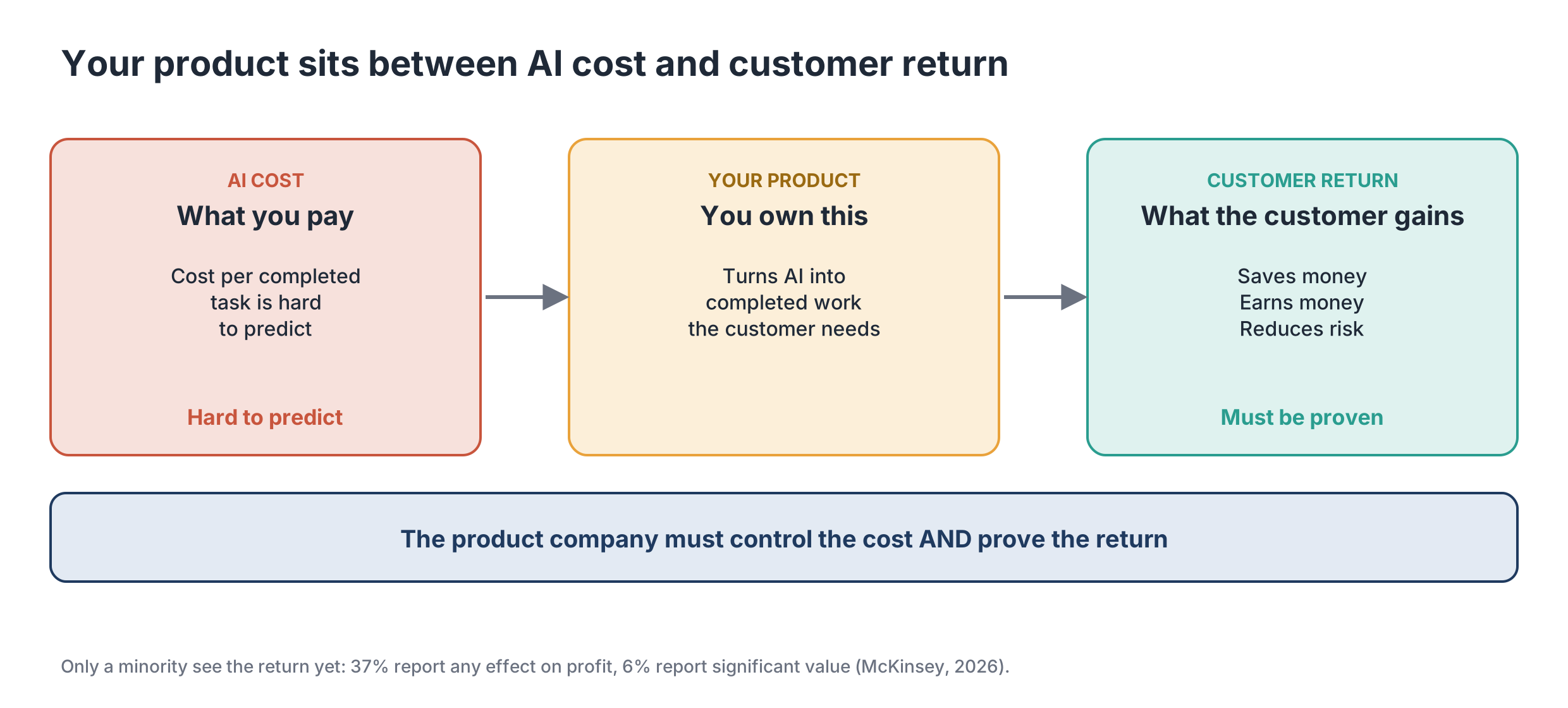
This is not only a finance or pricing problem. Our architecture decides how often a model runs. Our engineering decides how often it retries or fails. Our workflow design decides how much human review is still needed. Our billing design decides whether revenue grows when usage grows. So most of this work falls on product engineering, not only on finance.
Owning both is a big challenge for product companies, and it is what this article is about. Whichever way the price moves, we have learned that we need to watch the trends closely, follow good practices from across the industry to control the cost, and, most importantly, make sure the AI in our products produces a clear return for our customers.
AI is not a passing trend. Nearly 90% of companies already use it, and 60% of business leaders expect their companies to spend more on it next year.[1] Many enterprise customers now expect software vendors to explain where AI fits in their products, even when they are not yet willing to pay more for it. And your engineers already use AI to build.
So every product company now depends on two prices that nobody can predict:
- What you pay for AI. It can go down, and it can go up.
- Last year’s level of AI capability gets much cheaper every year.[2] Companies also tend to move to newer, more capable models, so they rarely get the full saving.
- Many of today’s prices may not be long-term prices. Leaked financial statements showed that OpenAI earned about $13 billion in 2025 but had an operating loss of about $21 billion.[3] These losses include training, research, staff and expansion, so they do not prove that each AI request is sold below cost.
- Flat-rate plans are giving way to metered or limited usage in parts of the business AI market. Anthropic said one user consumed “tens of thousands” of dollars of model usage on a $200 plan.[4] Under Anthropic’s revised enterprise model, the fee per user licence covers access to the platform, and all usage is billed separately at standard API rates. Existing customers move to the new model at renewal.[5]
- Other vendors are moving the same way. In April 2026, OpenAI introduced token-based rate cards and pay-as-you-go options for its Codex coding tool, for eligible business and enterprise customers.[6] Later that month, GitHub introduced token-based weekly limits for Copilot individual plans, saying agentic workflows had “fundamentally changed Copilot’s compute demands.”[7]
- Some prices have already gone up. When Gemini 2.5 Flash became generally available in June 2025, Google doubled its input price from $0.15 to $0.30 per million tokens. It also replaced its two output prices ($0.60 and $3.50) with one price of $2.50.[8]
- Usage can grow faster than prices fall. Uber used up a full-year AI tool budget in about four months.[9]
- What customers will pay you for AI. This is also uncertain. Many are still deciding whether AI features are worth paying extra for.
If what you pay goes up while what customers will pay goes down, you make less profit on each sale. Nobody can tell you where either price will be in two years. So we do not build a plan that depends on one guess. We build one that still works if AI costs double or halve:
- Track the cost of every AI feature per completed task, every month.
- Avoid depending on one model vendor, or on long fixed-price deals for AI features.
- Price AI features so your revenue grows when usage grows, instead of your costs alone.
In short
- Part 1: How customers judge AI value today — Most companies use AI, but only a minority report any profit impact, and few report significant value. Customers are starting to act on this.
- Part 2: What AI costs a product company — Costs change with usage and vendor pricing, and are harder to plan than cloud costs. This applies inside the product and in building it.
- Part 3: How to respond — Five ways we control AI cost and prove its value: architecture, measurement, engineering practice, financial controls, and pricing and contracts.
- Part 4: What to watch — Signals to track, three possible outcomes, and the questions we ask before building an AI feature.
Part 1: How customers judge AI value today
Customers use AI widely, but most cannot yet show that it makes them money. That is changing how they buy.
Use is high, profit is low
McKinsey’s 2026 survey found that nearly 90% of organizations use AI regularly in at least one business function. Yet only 37% reported any positive effect on operating profit, or EBIT (earnings before interest and taxes). Just 6% said AI had delivered significant value and contributed at least 5% of EBIT.[1]
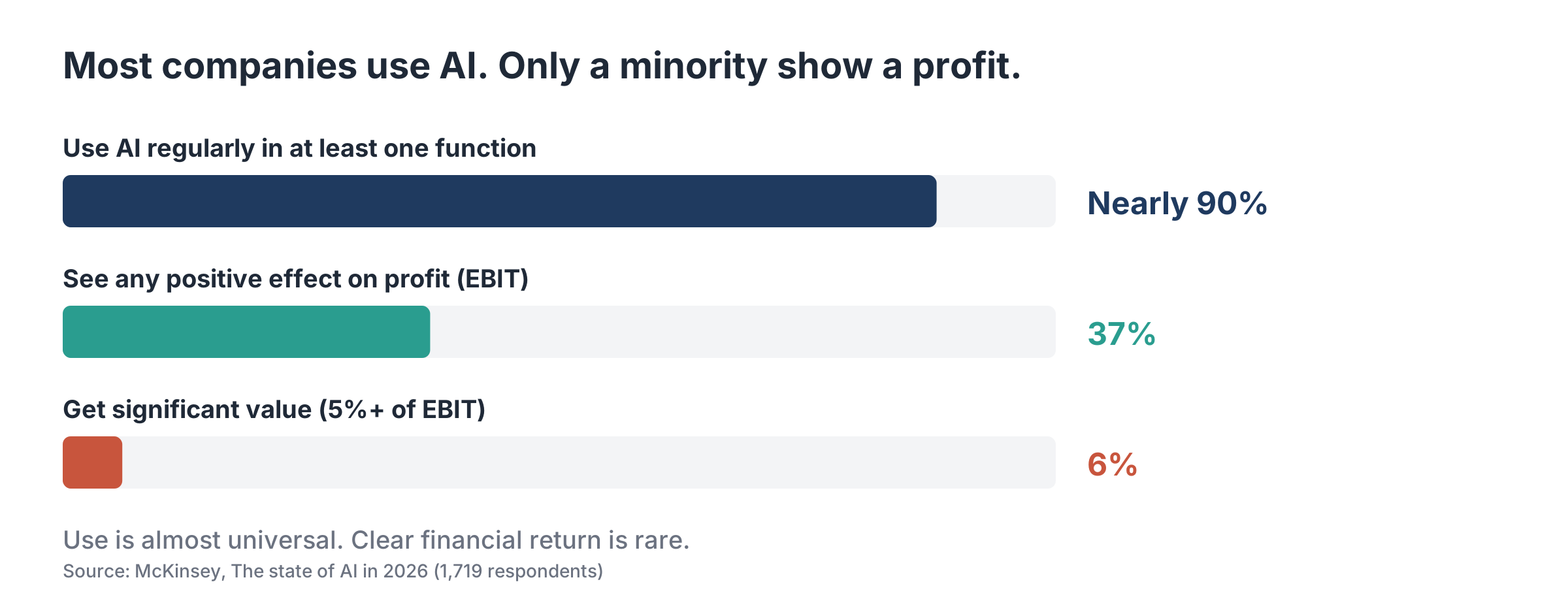
This does not mean AI spending will collapse. It means customers will ask harder questions. They will pay when AI completes useful work at a cost and quality they can measure.[1]
Six numbers to remember
| Signal | Finding | Why it matters |
|---|---|---|
| AI adoption | Nearly 90% use AI in at least one function.[1] | AI is becoming expected in business software. |
| Financial return | Only 37% report any positive EBIT effect.[1] | Use does not automatically create company profit. |
| Strong results | About 6% report significant value and at least 5% EBIT impact.[1] | Large returns stay with a small group. |
| Workflow redesign | Nearly 75% of high performers redesign workflows, compared with about 25% of others.[1] | Adding an AI button is not enough. The work itself must change. |
| Frontline adoption | Only 51% of frontline employees use generative AI regularly.[10] | Management enthusiasm does not guarantee daily use. |
| Build instead of buy | 32% rejected at least one product or feature because they believed they could build it with coding agents.[1] | Simple features are becoming easier for customers to copy. |
Why the surveys seem to disagree
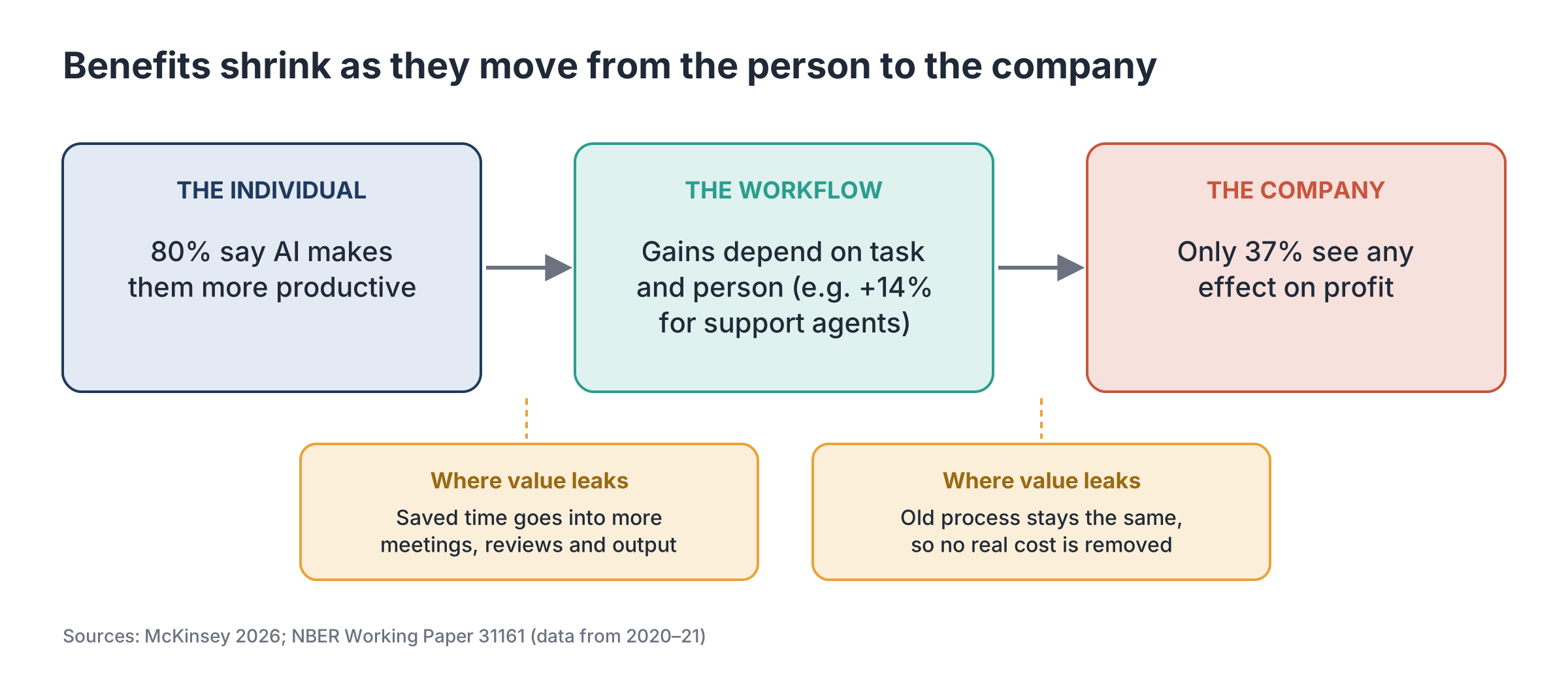
Some surveys say employees are saving time. Others say companies cannot show a return. Both can be true, because they measure three different levels. A customer judging your AI feature may be looking at any one of them.
Level 1: The individual
An employee may write an email, summarize a document or create code faster. McKinsey found that 80% of respondents believed AI improved their individual productivity.[1]
That benefit is useful, but it does not prove that the company earned more or spent less. The saved time may go into more meetings or more review, and never reach the financial results.
Level 2: The workflow
At the level of one business task, AI can help a lot. But how much it helps depends on who uses it and how well they use it. Studies from 2026 show this clearly:
- People with less skill gain the most. In an experiment with 1,174 adults solving a business problem, AI improved everyone’s results. It also closed about three-quarters of the gap between people with less and more education.[11]
- AI helps people do tasks they were not trained for. In a study of 673 IT apprentices in Germany, AI raised performance on tasks beyond their training by 26–31 percentage points. Apprentices who already knew how to use AI well gained the most.[12]
- People are poor judges of their own gain. In a 2025 trial, experienced developers were 19% slower with AI tools, but believed they were faster.[13] Newer tools are likely better, but there is no reliable new measurement yet.[14] The lesson remains: measure the gain, do not ask people to estimate it.
So a claim like “AI makes your team 30% more productive” means little on its own. The real question is: which users, doing which task, gain how much?
This is probably one reason why so many people say AI helps them, while far fewer companies see the benefit in their results. The gains differ from person to person, people tend to overestimate them, and they only reach company results when the work itself changes.
Level 3: The company
The last test is simple: does AI change the company’s revenue, costs or risk? Here the results are much weaker. Deloitte’s 2026 survey found that 66% of organizations saw productivity gains from AI and 40% saw lower costs, but only 20% saw higher revenue.[15]
Time saved by employees becomes money only when the company changes how the work is done. For example, it removes a process step, needs fewer outside contractors, avoids new hiring, or handles more orders with the same team. If none of these happen, employees feel the benefit, but the company’s results stay the same.
This is why companies that get large returns are about three times as likely to redesign their workflows.[1] For a product company, a feature that only saves time is hard to justify. The product should help the customer make one of these changes, and show the result in numbers.
How customers are acting on this
Customers are already changing what they do.
Klarna added human support when quality dropped
In 2024, Klarna said its customer-service assistant was doing the work of 700 full-time agents.[16] In 2025, its CEO said the company had put too much weight on cost, and service quality had dropped. Klarna kept the assistant but added human support: AI handles routine requests, and people handle difficult cases.[16][17]
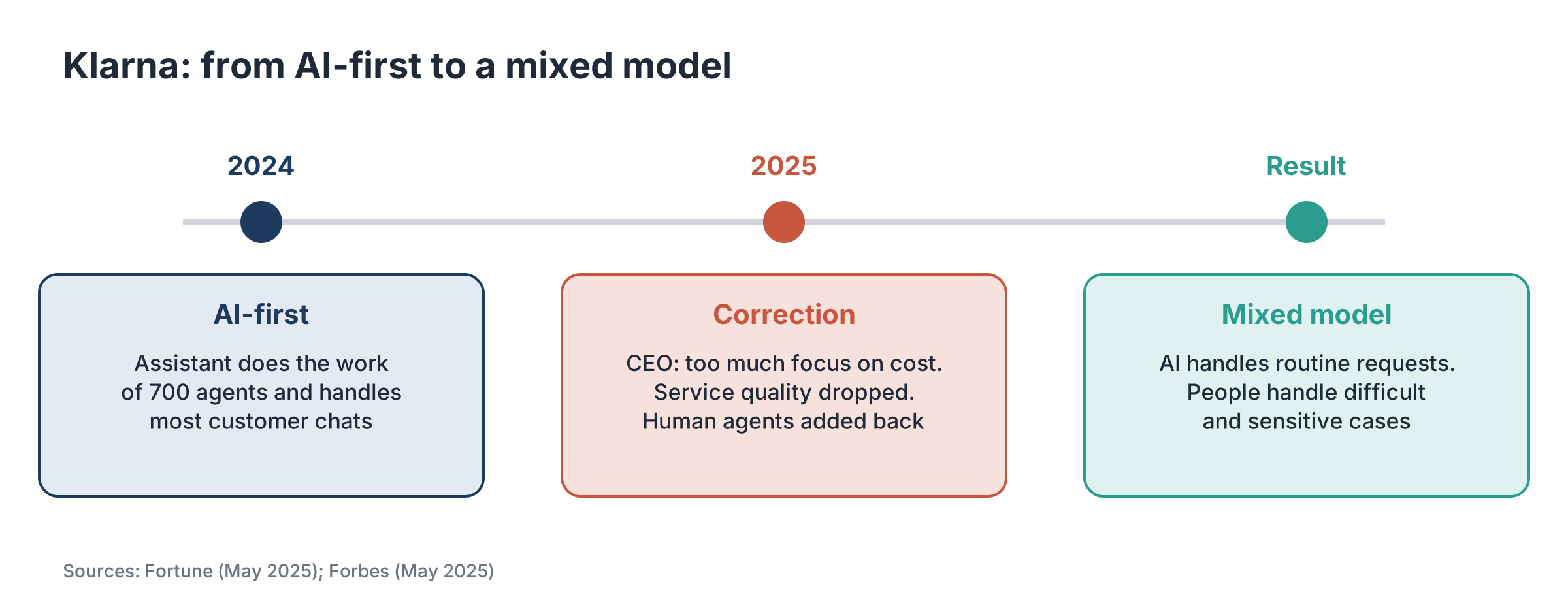
Lesson: Customers judge AI on quality as well as cost. Human fallback is not proof that the AI failed. It is part of a reliable design.
Some customers ask whether they need as many user licences
Most business software is sold as one licence per user. If one agent does the work of several people, the customer may need fewer licences. In February 2026, after Anthropic released new tools that could perform professional workflows, the S&P 500 Software & Services Index fell more than 4% in one day and was down about 20% for the year. Indian IT companies, including TCS and Infosys, also fell.[18] The new tools were the trigger, not the only cause: software was already the weakest part of the S&P 500 in 2026.[19]
This does not mean subscription software will disappear.[18] On February 17, Infosys and Anthropic announced a partnership to build AI agents for regulated industries.[20]
Lesson: Feature-only products and pricing per licence alone face more pressure. Products that hold trusted data and complete business work are still hard to replace.
Some customers now prefer to build software themselves instead of buying it
McKinsey found that 32% of organizations had rejected at least one software product or feature because coding agents made internal development appear possible.[1]
This records a buying decision, not a successful system in production. The survey does not show whether tools built in-house are cheaper to run over time, once integration, security, support and maintenance are included.[1]
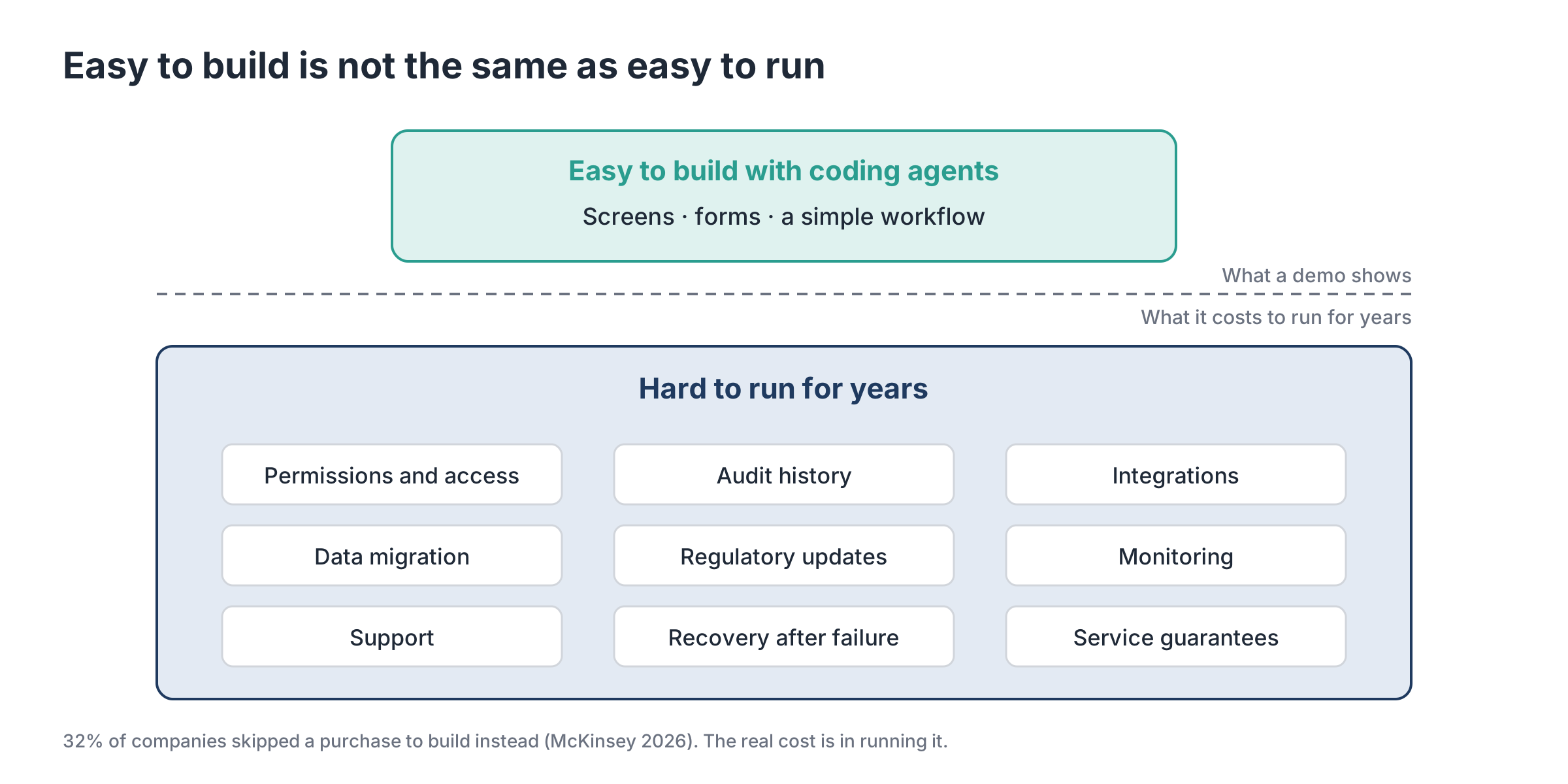
A customer can generate a screen or a simple workflow quickly. Permissions, audit history, integrations, regulatory updates, support and recovery are much harder to build and maintain.
Lesson: Do not compete only on how quickly a feature can be coded. Compete on the full cost and risk of running it for years, and show that to buyers.
Part 2: What AI costs a product company
AI adds a cost each time a customer uses a feature, and another cost when your own team uses AI to build. Both are harder to plan than cloud hosting.
Why AI costs are harder to plan than cloud hosting
When companies moved to the cloud, the monthly bill became much harder to predict. It took years of practice to bring it under control.
Even now, cloud cost is not easy to control. In Flexera’s 2026 survey of more than 750 cloud users, 85% said managing cloud spend was their top cloud challenge. They estimated that 29% of their cloud spend was wasted on resources they did not need. This figure went up for the first time in five years, as AI workloads grew.[21]
AI brings the same problem back in a harder form. If AI use is not managed carefully, spending can go well over budget. Uber, for example, used up its full-year AI tool budget in about four months. That means it was spending at about three times the planned rate.[9]
There are two reasons. First, the bill follows how much customers, employees and agents use AI, and that can change quickly. Second, AI vendors change their prices, limits and billing rules often, sometimes within weeks.
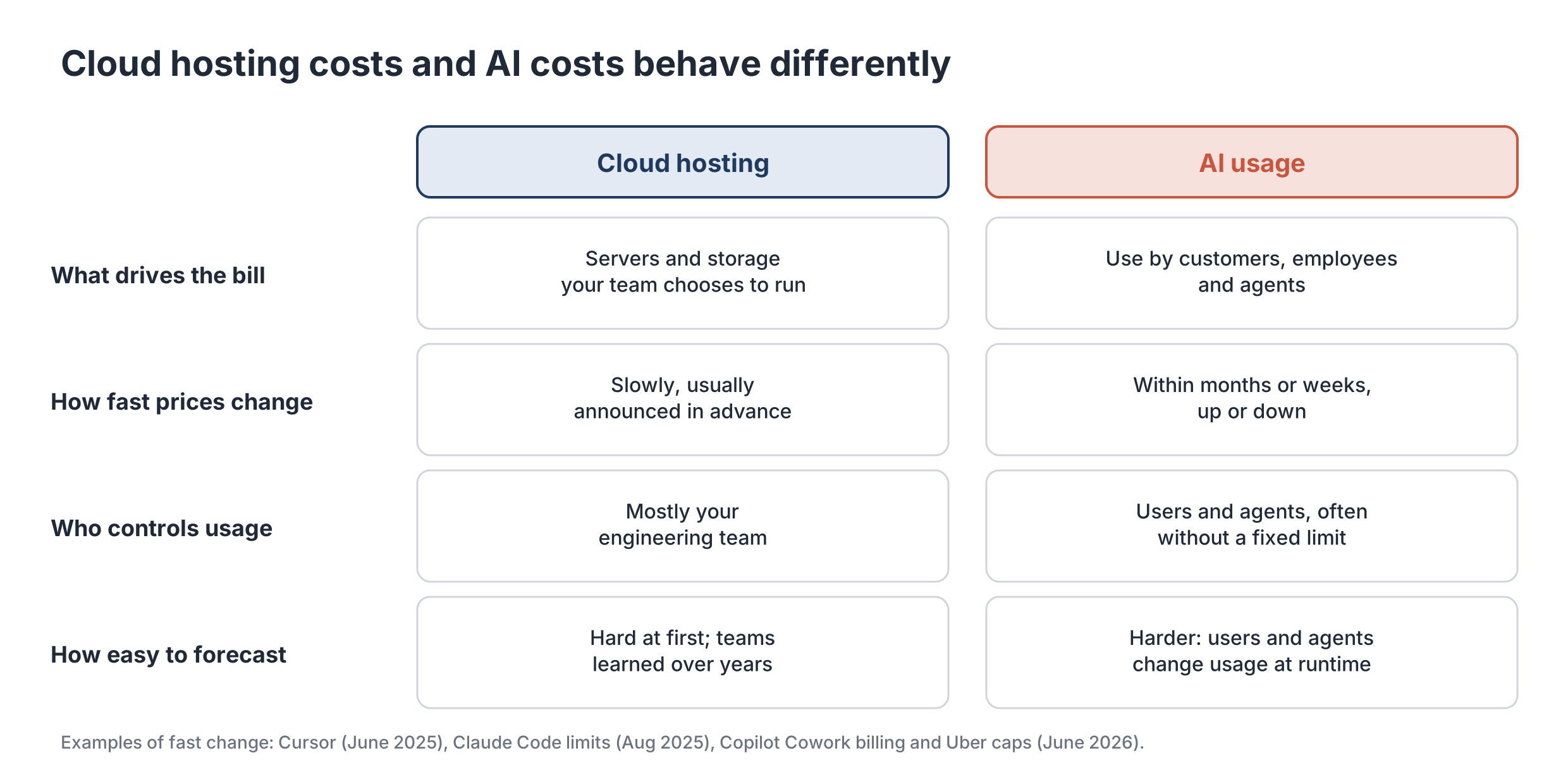
These recent changes show how fast AI prices and rules change:
| When | What changed |
|---|---|
| June 2025 | Cursor moved its Pro plan from a fixed number of requests to token-based limits. Some users received unexpected bills, and Cursor offered refunds.[22] |
| August 2025 | Anthropic added weekly usage limits for Claude Code on its paid plans, to manage heavy, round-the-clock use.[23] |
| June 2026 | Microsoft moved its Copilot Cowork feature to usage-based billing.[24] |
Each change makes sense on its own. Together, they show that a cost plan made today may need to change within months.
Token usage adds a further problem. A fixed cloud server has a predictable hourly price. An AI request does not. One request can cost ten times more than the next, and users and agents, not your team, make many of the choices that decide this.
Cost inside the product
For many normal software features, the extra cost of each use is small and predictable. AI features are different: each use can cost much more, and the amount varies. Two things affect this cost, and they work in opposite directions.
First, the price of a given level of AI capability is falling very fast. Epoch AI found that the price to reach a fixed level of performance fell by between 9 and 900 times per year, depending on the task. For one benchmark of GPT-4-level science questions, the price fell about 40 times per year.[2] But companies usually move to newer, more capable models, so this saving rarely reaches the bill in full. Open-weight models, which anyone can download and run, are also close behind the best closed models.[25] So access to a strong model is unlikely to stay a lasting reason to charge more. The lasting value must come from the workflow, trusted data, reliability and integration.
Second, the physical side of AI is not getting cheaper in the same way. Strong demand for AI hardware has created memory shortages. In November 2025, the CEO of cloud provider OVHcloud forecast that identical servers would cost 15–35% more by December 2026, and that some of its cloud products would rise 5–10% during 2026. This is one provider’s forecast, not a market-wide figure.[26] Power and data center capacity are also limited in many regions.
The result is that the price per task can fall while the total bill rises, because usage grows faster than prices fall.
Cost of building the product with AI
The second cost is inside your own engineering team. Coding agents are becoming a normal part of product development in many engineering teams, and they are paid for by use.
According to The Information, as summarized by AI Magazine, Uber’s CTO said in April 2026 that heavy use of Claude Code and Cursor had used up the company’s full-year AI-tool budget within the first few months. Engineers had been encouraged to use the tools, including through internal usage leaderboards.[9]
The same reporting said AI agents were already writing about 11% of Uber’s live backend code updates. The problem was not a tool nobody used. It was a useful tool whose use grew much faster than expected.[9] In June 2026, Uber limited each employee to $1,500 a month in AI coding tool spending per tool.[27]
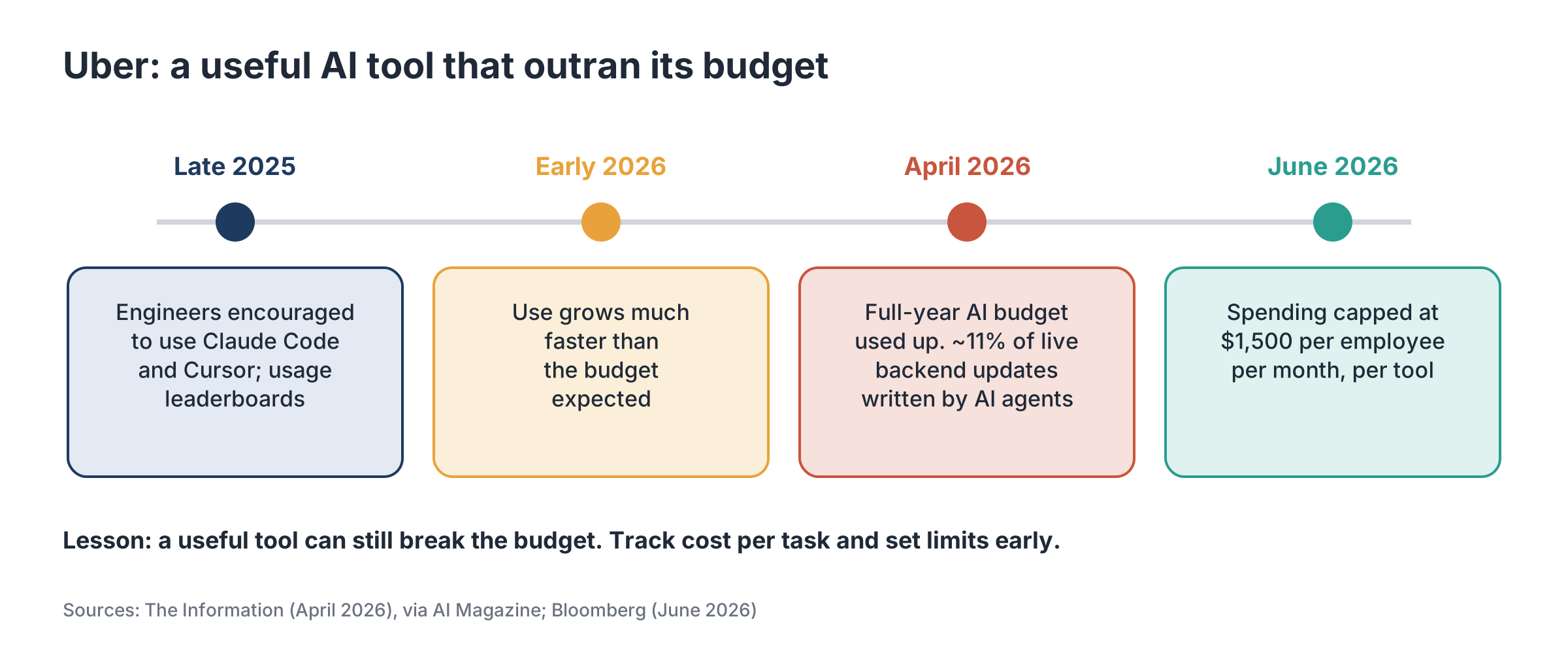
So engineering leaders pay a cost that keeps changing, for a gain that is real but hard to measure, as the METR studies in Part 1 showed.
Lesson: Track AI cost per completed piece of work, both in the product and in the team, not only the total bill. Part 3 shows how.
Part 3: How to respond
Getting cloud costs under control needed architecture, engineering and measurement, not only finance. AI costs need the same, and more, because a budget alone cannot control a cost that changes with every request. We use five ways to control AI cost and prove its value.
Why this matters for engineers
Calling a model is now easy. Making an AI workflow reliable, safe and affordable in production is much harder. Most of the work below is engineering work, not model work. Engineers who can do it well will be worth more to product companies than engineers who can only add a model to an app.
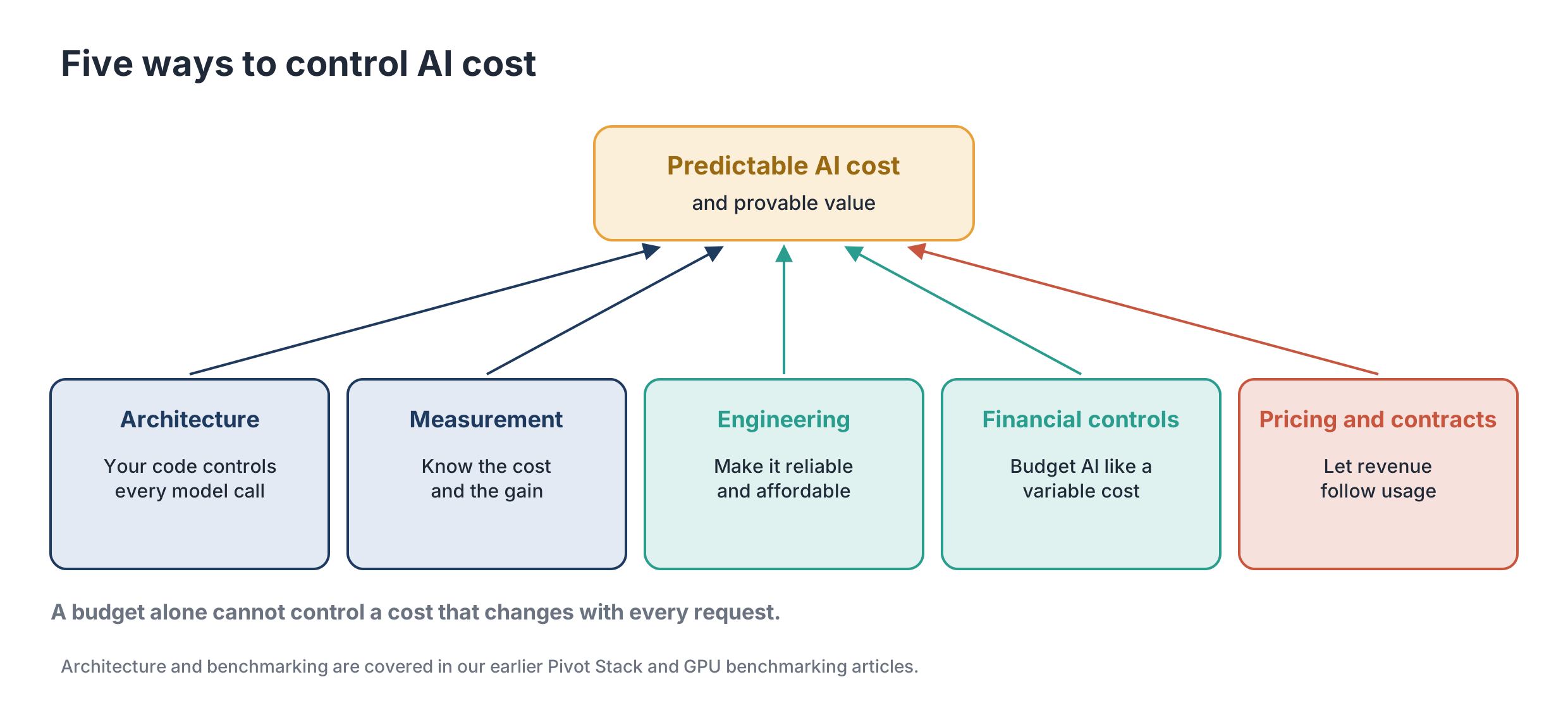
1. Architecture: keep control of every model call
Mainly for: architects and senior engineers
Decide where AI is allowed to act, and keep control of every model call in your own code. In our Pivot Stack architecture, the deterministic core decides when the model is called, and users never call the model directly. So the product, not the model, controls how much AI is used. We described this in our earlier article on Pivot Stack.
Design the system so models can be swapped. Prices, limits and the best model change every few months. A product tied to one provider cannot benefit from falling prices, or escape a rising one.
But do not assume models are interchangeable. Test each replacement on your own tasks, because models differ in output format, tool use, speed and how they fail. Swapping a model is not like swapping a database driver.
2. Measurement: know the cost and the gain
Mainly for: product leaders and engineers
Start from a unit of work. Customers will increasingly pay for completed work they can measure. So start every AI roadmap item with a business task: a resolved support request, an approved return, a reconciled invoice, an accepted order or a fixed vulnerability.
Before development starts, record the current cost, time, error rate and human effort for that task. Without this starting point, the team cannot prove that the AI product improved anything, and the customer cannot see the return.
As Part 1 showed, the work itself must be redesigned. Product managers should define which steps disappear and which stay with people.
Track cost per completed task. Record model calls, token use, tool calls, retries, cache hits and human-review time for every AI workflow. Connect those costs to a business result, and track gross profit per completed task. A workflow can be popular and still lose money.
Track cost per customer. A product can look profitable on average while a few heavy customers use most of its margin. Anthropic saw this with its flat-rate plans, where one user consumed tens of thousands of dollars of usage on a $200 plan.[4] Track AI cost and gross margin per customer, and how much of your total AI cost comes from your heaviest customers.
Benchmark before you commit. Know the real cost and quality of each model for each task before you choose it. Our earlier article on using GPUs to benchmark AI workloads covers one way to do this.
Test the whole workflow. A model benchmark is not a production test. Test realistic cases, missing data, unavailable tools and recovery after failure. Measure completion rate, exception rate, human overrides and cost per accepted result, not only answer quality.
3. Engineering practice: make it reliable and affordable
Mainly for: engineers
AI reliability is now a core software-engineering problem, not only the data-science team’s job.
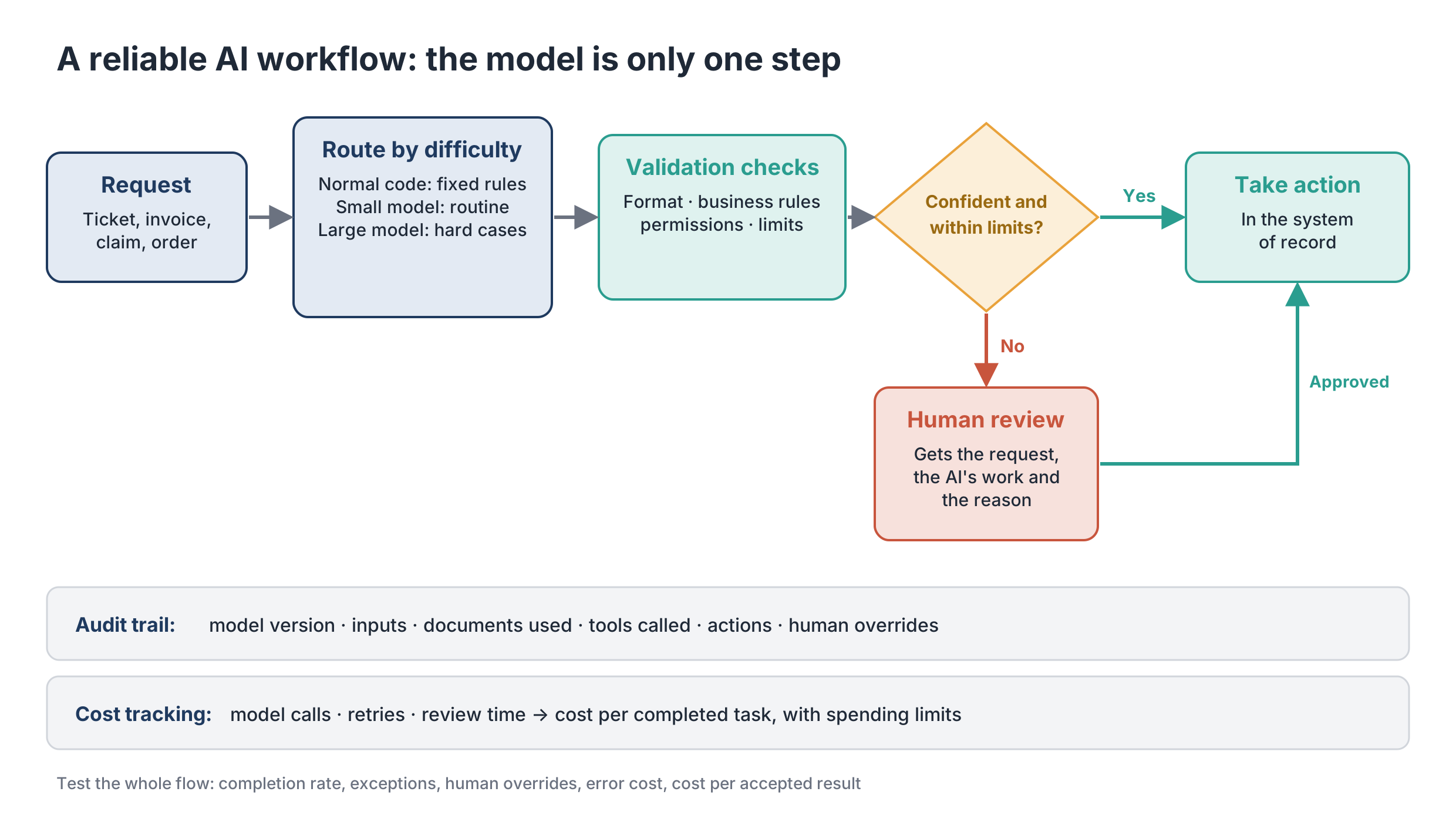
Route work by difficulty. Do not use the most expensive model for every step. Use normal code for fixed rules, smaller or open-weight models for routine sorting and classification, and the largest and most expensive models only when a task needs deeper reasoning. Set budgets and time limits for agent loops. Cache repeated context and reuse checked results. McKinsey found that AI running costs already limit AI use at 20% of organizations.[1]
Add validation checks. Do not send model output directly into an important business action. Check formats, required fields, business rules, permissions and policy limits before anything happens. When a wrong answer is costly, add a second check: normal code, a rules engine, another model or a person. The goal is to stop uncertain output from causing harm that cannot be undone.
Design human fallback. Define when the system must stop and ask a person, using confidence limits, exception types and transaction limits. The person must receive the original request, the AI’s work and the reason for escalation, so nobody has to start again. Klarna’s experience shows that easy human access protects quality while AI handles routine volume.[16]
Keep an audit trail. Record the model version, inputs, tools called, actions taken and human overrides. This makes failures easier to investigate. Governance also affects buying decisions. IBM found that 20% of breached organizations had an incident involving unapproved AI tools, while 63% had no AI governance policy.[28] Enterprise customers will increasingly expect access controls, logging and data policies inside the product.
4. Financial controls: budget AI like a variable cost
Mainly for: engineering leaders
- Set a budget per team and per engineer. Use spending limits and early alerts, as Uber did after its budget ran out. Review the limits every quarter, because prices and usage change quickly.
- Measure cost per shipped change. Compare the AI tool bill with work delivered: merged changes, fixed defects and released features. A rising bill with flat delivery is a warning sign. Use this number as a warning signal, not as proof of productivity, because it also changes with the type of work and the size of each release.
- Be careful with usage targets. Leaderboards can push spending up without improving output. Reward results, not tool use.
- Keep more than one tool option. Vendor prices and limits change. Teams that can switch tools or models are less exposed to one vendor’s decisions.
5. Pricing and contracts: let revenue follow usage
Mainly for: product leaders and pricing teams
Pricing per user licence still works for assistive tools, but it becomes weaker when AI reduces the number of users needed. FTI found that 83% of software vendors include AI in their main product, while 89% believe usage-based pricing matches AI revenue and cost more closely.[29]
Pricing on business outcomes sounds attractive but is still rare. Only 2 of 321 software pricing leaders in one survey used it, because agreeing on what caused an outcome and who carries the risk is difficult.[30]
A staged approach is more practical. Move up a step only as the product proves its value.
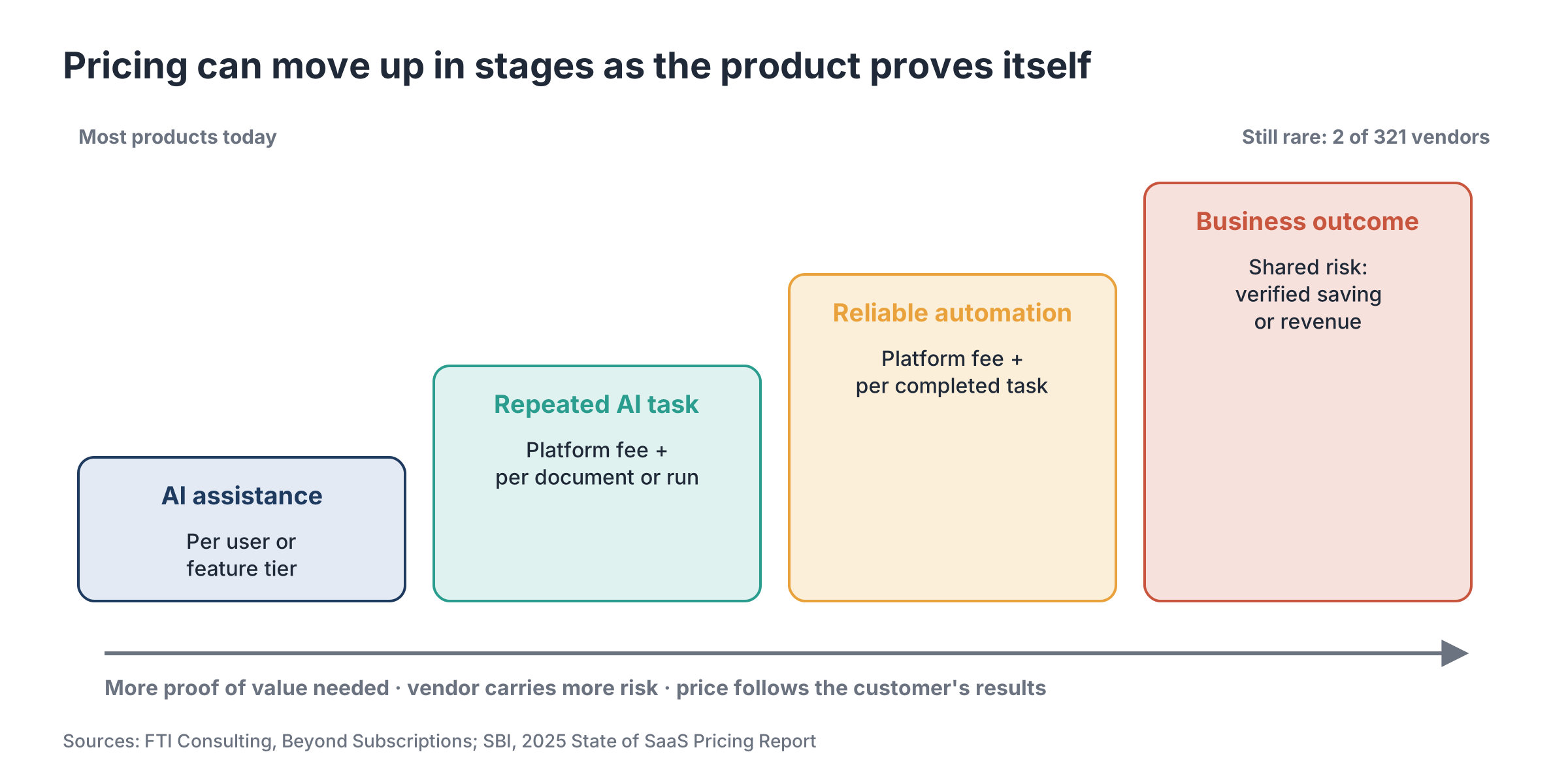
| Product stage | Suitable pricing | Example measure |
|---|---|---|
| AI assistance | Base subscription plus role-based access or usage allowance | Active user or feature tier |
| Repeated AI task | Platform fee plus usage charge | Document, case or workflow run |
| Reliable automation | Platform fee plus charge per successful completion | Accepted transaction or resolved ticket |
| Measurable business outcome | Shared-risk contract with limits | Verified saving, collected revenue or avoided loss |
Do not show tokens as the main customer metric unless the buyer is a developer. A business buyer understands processed invoices and resolved cases.
Because AI costs move quickly, leave room in contracts for that. Review prices at fixed intervals, and avoid long fixed-price deals for features whose cost you cannot yet predict.
Making usage and outcome pricing work in practice
Charging per completed task sounds simple. The hard part is agreeing on what was completed. If the customer cannot check the bill, every invoice can become a dispute. These steps reduce that risk.
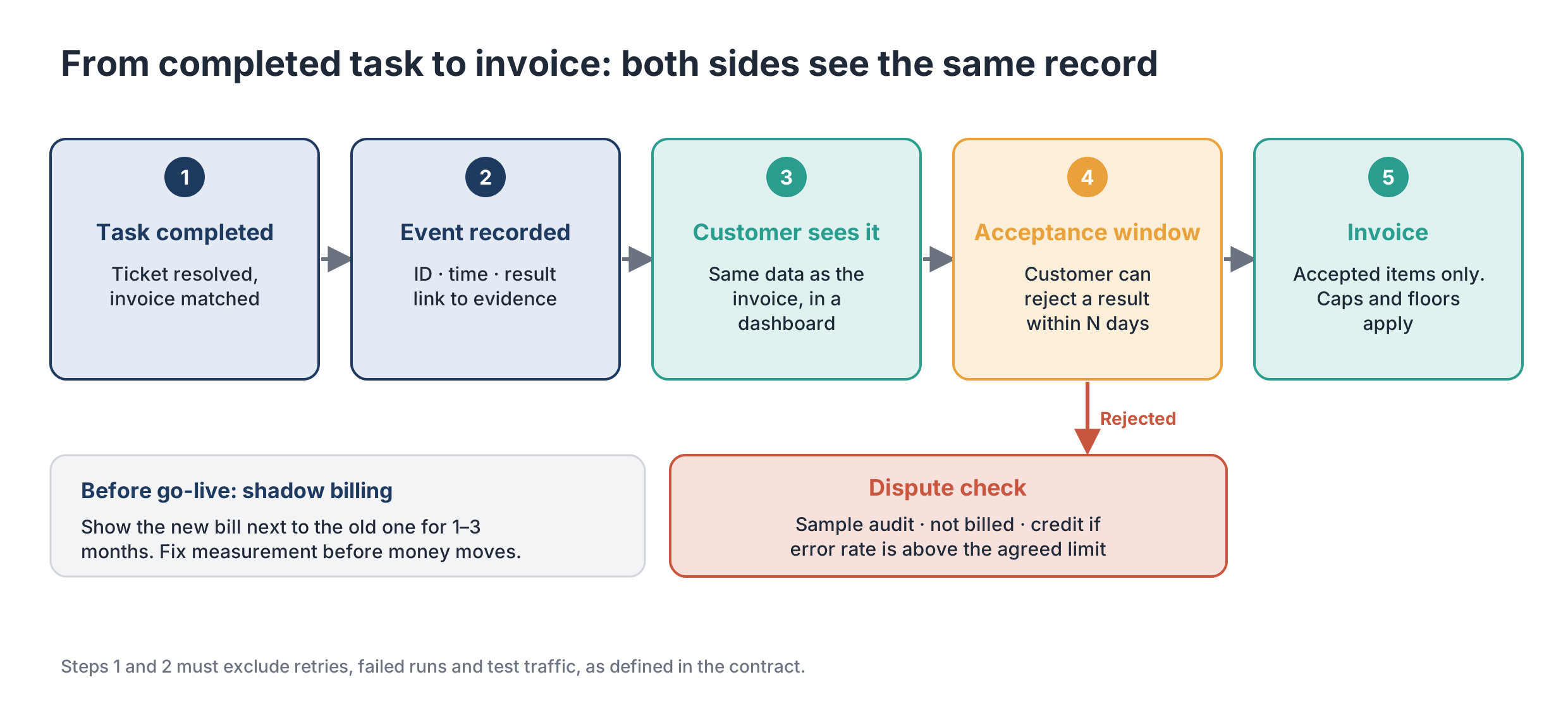
- Define the billable unit in the contract. Say what counts as one unit, and what does not, such as retries, failed runs and test traffic.
- Record every billable event with its evidence. Use the same record for the invoice and the customer’s dashboard, so both sides see the same numbers.
- Give the customer an acceptance window. Results rejected within the agreed days are not billed.
- Start with shadow billing. For one to three months, keep the old pricing and show what the new bill would have been.
- Set floors, caps and alerts. Caps and alerts protect the customer from surprise bills, as the Cursor and Uber examples showed. A floor protects the vendor’s base revenue.
- Agree how disputes are checked. Use sample audits, and a fixed credit if errors pass an agreed level.
- Start with outcomes the product controls. A resolved ticket is easier to define and check than revenue or savings, which depend on much outside the product. Leave shared-risk contracts until measurement is trusted.
Teams that have built payment systems will recognise this work. It is reconciliation: two parties agreeing, item by item, on what is owed.
Part 4: What to watch
Nobody knows exactly how customer views and AI costs will develop. This part lists the signals worth tracking, three possible outcomes, and the questions we ask before building an AI feature.
Signals to track
| Area | Signal | Why it matters |
|---|---|---|
| Customer value | Usage and renewal rates of your AI features | Low repeat use is the earliest sign a feature will be cut. |
| Customer value | How often customers ask for ROI evidence at renewal | Shows whether your customers have started asking for proof of value. |
| Customer value | Deals lost because the customer chose to build | Shows how exposed your features are to coding agents. |
| Customer value | The next McKinsey, Deloitte and BCG figures on profit impact | Shows whether the gap between use and profit is closing. |
| Cost | Your cost per completed task, month by month | The best measure of whether an AI feature can make money. |
| Cost | Price, limit and billing changes from your model and tool vendors | These can change your margins with little notice. |
| Cost | AI development tool spend per engineer, against work shipped | Shows whether building with AI is paying off. |
| Cost | Server, memory and GPU price notices from cloud providers | Shows whether your hosting costs are rising. |
Three possible outcomes
Each outcome changes the two prices in a different way.
Outcome 1: Selective growth. This is the most likely outcome based on current evidence. AI spending keeps growing, but money moves toward work that shows clear value. General AI assistants become cheaper or are included in other products.
- The two prices: the price per task falls but usage grows; customers pay only for AI that completes measurable work.
- What to do: build narrow workflows and expand only after measuring results (see Measurement in Part 3).
- Signal to watch: usage and renewal rates of your AI features.
Outcome 2: A spending correction. If company profits do not improve, buyers cut unused licences, duplicate tools and expensive experiments. Gartner expects more than 40% of agentic AI projects to be cancelled by the end of 2027 because of cost, unclear value or weak risk controls.[31] This is a warning about weak projects, not a sign that AI will end.
- The two prices: vendors may raise prices or tighten limits; customers pay less and ask harder questions at renewal.
- What to do: make sure the core product stays valuable without an AI premium, and keep AI cost under firm control (see Financial controls in Part 3).
- Signal to watch: customers asking for proof of value, and price changes from your AI vendors.
Outcome 3: Faster automation. Models improve quickly enough to automate much more work. Demand for AI grows, but demand for software sold per user licence falls. Simple features become easier for customers to build themselves.
- The two prices: usage rises sharply; customers buy fewer licences but pay more per completed task.
- What to do: own the trusted data, permissions and transaction layer that agents need, and move pricing toward completed work (see Architecture and Pricing in Part 3).
- Signal to watch: deals lost because customers chose to build it themselves.
The five ways in Part 3 help in all three. The signals above show which one is starting.
The questions we ask before building an AI feature
Before we build an AI feature, we try to answer these questions. They follow the two prices from the start of this article.
What customers will pay us
- What complete business task will this feature finish or improve?
- What does that task cost today, in time, money and errors?
- How will the customer see the gain in numbers, and will they pay for it?
- Why would the customer buy this, instead of building it or getting it from a larger vendor?
What we will pay for AI
- What human review will still be needed, and what will it cost?
- Will we still make money if AI prices double or halve, or if a few customers use far more than average?
Conclusion
AI is here to stay, but its cost and its value are still moving. We do not know where they will settle, and neither does anyone else. What we can do is measure both closely, build products that still work if AI prices move up or down, and charge for work customers can see. Software companies that do this will keep their place in the customer’s budget. Products that offer little more than an AI button will be the easiest to cut.
References
- McKinsey & Company, The state of AI in 2026: On the road to ROI (August 2026; survey of 1,719 respondents in 97 countries). ↩a ↩b ↩c ↩d ↩e ↩f ↩g ↩h ↩i ↩j ↩k ↩l ↩m
- Epoch AI, AI inference price trends (March 2025). ↩a ↩b
- Gigazine, OpenAI’s financial documents show revenue of $13 billion and a large loss in 2025 (June 2026), summarizing reporting by the Financial Times and Ars Technica. ↩
- Simon Willison, Anthropic’s new weekly limits (July 2025), quoting Anthropic’s announcement. ↩a ↩b
- The Register, Anthropic ejects bundled tokens from enterprise seats (April 16, 2026). ↩
- OpenAI Help Center, Codex pricing (2026). ↩
- Simon Willison, Changes to GitHub Copilot (April 22, 2026), quoting GitHub’s announcement. ↩
- Google for Developers, Gemini 2.5: Updates to our family of thinking models (June 2025). ↩
- Original interview in The Information (April 2026); summarized by AI Magazine, Why Uber Has Already Burned Through Its AI Budget. ↩a ↩b ↩c ↩d
- BCG, AI at Work: Momentum Builds, but Gaps Remain (2025). ↩
- Cruces, Fernández Meijide, Galiani, Gálvez and Lombardi, Does Generative AI Narrow Education-Based Productivity Gaps? Evidence from a Randomized Experiment, NBER Working Paper 34851 (February 2026, revised May 2026). ↩
- Brosch, Langer, Lergetporer, Mueller, Pfeifer and Tschöpe, Task Expansion with Generative AI: Experimental Evidence on Middle-Skilled, Early-Career Workers, Stanford Digital Economy Lab working paper (October 2026). ↩
- METR, Measuring the Impact of Early-2025 AI on Experienced Open-Source Developer Productivity (July 2025). ↩
- METR, “We are Changing our Developer Productivity Experiment Design” (February 2026), listed on METR Research. ↩
- Deloitte AI Institute, The State of AI in the Enterprise, 2026. ↩
- Fortune, As Klarna flips from AI-first to hiring people again… (May 2025). ↩a ↩b ↩c
- Forbes, Klarna Reverses on AI, Says Customers Like Talking to People (May 2025). ↩
- CNBC, AI fears pummel software stocks: Is it ‘illogical’ panic or a SaaS apocalypse? (February 6, 2026). ↩a ↩b
- Implicator, Software Lost $300 Billion in a Day. Anthropic Was Just the Excuse. (February 2026), citing Bloomberg data. ↩
- Anthropic, Anthropic and Infosys partnership announcement (February 2026). ↩
- Flexera, 2026 State of the Cloud Report: press release (March 18, 2026). ↩
- Simon Willison, Cursor: Clarifying Our Pricing (July 2025), quoting Cursor’s announcement. ↩
- AIN, Anthropic introduces weekly limits for Claude Code (July 2025). ↩
- Data#3, The free ride is over: Copilot Cowork’s new payment model (June 2026). ↩
- Stanford HAI, 2026 AI Index Report: Technical Performance (April 2026). ↩
- Techzine, OVH expects cloud prices to rise in 2026 (November 2025). ↩
- Bloomberg, Uber Caps Usage of AI Tools Like Claude Code to Cut Costs (June 2, 2026). ↩
- IBM, Cost of a Data Breach Report 2025. ↩
- FTI Consulting, Beyond Subscriptions: SaaS AI Pricing. ↩
- SBI, 2025 State of SaaS Pricing Report. ↩
- Gartner, Gartner Predicts Over 40% of Agentic AI Projects Will Be Canceled by End of 2027 (June 25, 2025). ↩